
Why Industry-Aligned Skill Development Delivers Higher CSR Impact
29th January 2026
Beyond Certificates: Building Careers That Actually Last
Every year, thousands of young Indians complete vocational training programs. They receive certificates, attend graduation ceremonies, and return home with renewed hope. Yet within months, many find themselves back where they started—unemployed or underemployed, their hard-earned certificates gathering dust in drawers.
For corporate India, who are investing millions in CSR-driven livelihood programs, this may be construed as a fundamental failure to create the measurable, sustainable impact that these organizations seek.
The difference between training that leads to certificates and training that transforms lives lies in one critical factor: Industry Alignment.
The Training-to-Employment Gap: Why Many Programs Fail
The reality of India’s Skill Development Landscape is not as rosy as it seems. While completion rates might look impressive on paper, what happens after the certificate ceremony reveals the true measure of success—or failure.
The Five Critical Failure Points
1. Outdated Curricula Disconnected from Reality
Many training programs operate with curricula designed years ago, disconnected from current industry practices. A ‘phlebotomy’ student trained on outdated collection techniques, a ‘trainee chef’ learning recipes no restaurant serves anymore, or a ‘data analyst’ studying tools the industry abandoned two years ago—these graduates walk into interviews unprepared for the actual demands of their chosen fields.
2. Theory-Heavy, Practice-Light Approaches
Classroom learning alone cannot prepare someone for the fast-paced, unpredictable nature of real work environments. A ‘personal care attendant’ who has never handled the pressure of a hospital ward, a ‘chef’ who hasn’t experienced the chaos of a busy kitchen during peak hours - these individuals lack the muscle memory and confidence that only hands-on experience provides.
3. No Connection to Actual Employers
Perhaps the most damaging gap: Training Programs that operate in isolation from the employers they claim to serve. Without direct input from hospitals, restaurants, IT companies, and other potential employers, these programs make assumptions about what skills matter. The result? Graduates trained for jobs that don’t exist or lacking skills that every employer considers essential.
4. Lack of Soft Skills and Workplace Readiness
Technical skills alone don’t make someone employable. Programs that include communication skills, professional etiquette, teamwork, problem-solving, and workplace discipline produce graduates who know their craft and can also navigate actual work environments. But this is not the usual scenario. Employers consistently report the lack of attitude and adaptability as a major drawback of these skill training programs.
5. Training Without Transition Support
Even well-trained candidates struggle when left to navigate job markets alone. Without resume building, interview preparation, job matching services, and post-placement support, many trained youth simply don’t know how to convert their skills into employment opportunities.
The Industry-Alignment Advantage: A Different Approach
Industry-aligned skill development represents a fundamental shift from traditional training models.
Instead of asking ‘What can we teach?’, it asks ‘What do employers actually need?’ This question changes everything.
Employer-Linked Curriculum Design
At Neotia Skill Development Academy, our curricula aren’t created in isolation. We work directly with hospitals, healthcare facilities, hotels, restaurants, IT companies, and other employers to understand:
- What specific skills do entry-level employees need from day one?
- Which tools, technologies, and techniques are currently in use?
- What gaps do they see in candidates from other training programs?
- What soft skills and workplace behaviours matter most?
- How is the industry evolving, and what skills will matter in 6-12 months?
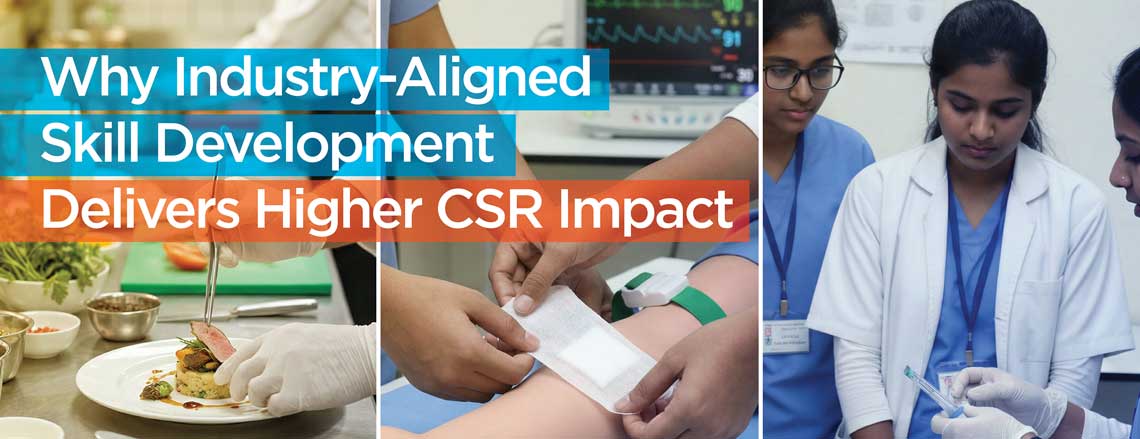
This means a phlebotomy student learns the exact blood collection procedures used in local hospitals. A trainee chef practices the cuisine styles and cooking methods that Kolkata’s and other Indian restaurants actually serve.
The result? Graduates who walk into interviews already familiar with what their potential employers need. No translation required. No adaptation period. Just readiness.
Hands-On Training and Real-World Internships
Industry alignment means training doesn’t happen only in classrooms. At NSDA, our approach integrates:
Simulation-Based Learning: Before personal care attendants (PCA) enter hospitals, they practice in simulated ward environments. Before chefs cook for customers, they handle the pressure of timed cooking challenges that mirror real kitchen demands.
Industry Internships: Our students don’t just learn about healthcare or hospitality or IT—they work in these environments. They experience the pace, the pressure, the protocols, and the people. They make mistakes in safe, supervised settings where errors become learning opportunities rather than deal-breakers.
Industry Mentorship: Working professionals serve as mentors, sharing not just technical knowledge but the unwritten rules of their industries. How do you handle a difficult patient? What do you do when the kitchen runs out of a key ingredient? These insights can’t be taught from textbooks.
This hands-on approach builds more than skills—it builds confidence. By the time our students graduate, they’ve already proven to themselves and to potential employers that they can handle the job.
Placement Readiness: Beyond the Certificate
Here’s where industry-aligned programs dramatically outperform certificate-based training: we don’t just prepare students to pass exams; we prepare them to pass interviews and excel in jobs.
Professional Communication: From day one, students practice professional English communication, workplace etiquette, and effective interpersonal skills. They learn how to present themselves, how to ask questions, how to give and receive feedback.
Resume Building and Interview Skills: Every student graduates with a professional resume highlighting their skills, internship experiences, and achievements. They’ve practiced mock interviews, received feedback, and know how to present their strengths confidently.
Workplace Readiness: Understanding punctuality, teamwork, problem-solving, ethical behaviour, and professional responsibility. These aren’t afterthoughts—they’re integrated throughout the training program.
Digital Literacy: In today’s workplace, basic digital skills aren’t optional. Our students learn to use email professionally, navigate workplace software, and adapt to digital workplace tools.
The difference shows up in placement rates. While many training programs celebrate 30-40% placement success, industry-aligned programs consistently achieve 70-85% placement rates—and these placements tend to last because the graduates are genuinely prepared for what they encounter.
How CSR Partners Benefit from Higher Success Rates
When your CSR investment supports industry-aligned skill development, the returns extend far beyond individual success stories. You gain measurable, reportable, sustainable impact that aligns with your organization’s values and objectives.
Measurable Impact Metrics
High Placement Rates: Track exactly how many youth secure employment, what positions they obtain, and their starting salaries. No vague claims—concrete numbers.
Job Retention: Monitor how many graduates remain employed after 6 months, 12 months, and beyond. Industry-aligned training produces employees who succeed and stay.
Income Impact: Document the transformation from no income to stable, respectable livelihoods. Track career progression and income growth over time.
Employer Satisfaction: Survey employers about their satisfaction with graduates. When employers actively request more candidates from your program, you know you’re creating real value.
Alignment with UN Sustainable Development Goals
Quality skill development directly advances multiple SDGs:
- SDG 1 (No Poverty): Moving youth from unemployment to stable incomes
- SDG 4 (Quality Education): Providing relevant, effective vocational training
- SDG 8 (Decent Work): Creating pathways to dignified, sustainable employment
- SDG 10 (Reduced Inequalities): Opening opportunities for marginalized youth
Multiplier Effects
Every successfully placed graduate creates ripple effects:
Family Impact: A single income can lift an entire family. Parents can breathe easier. Younger siblings see education and hard work leading to real opportunities. The cycle of poverty begins to break.
Community Inspiration: Successful graduates become role models. Their neighbors’ children see that opportunity exists. Hope spreads.
Economic Contribution: Employed youth become consumers, taxpayers, and economic participants. They contribute to growth rather than depending on support.
Brand and Employee Engagement
CSR partnerships with high-impact skill development programs offer unique engagement opportunities:
Employee Volunteerism: Your employees can serve as mentors, mock interviewers, or career counsellors. This creates meaningful volunteer experiences while directly contributing to program success.
Success Stories: Real transformation stories—complete with names, faces, and documented outcomes—become powerful content for your CSR communications.
Stakeholder Confidence: Investors, customers, and partners increasingly evaluate companies on social impact. Demonstrating high-success-rate livelihood programs builds credibility and trust.
Cost Effectiveness
Industry-aligned programs deliver more impact per rupee invested. When placement rates double or triple compared to generic training programs, your CSR budget creates proportionally more employed youth, more transformed families, and more measurable change. The return on social investment becomes demonstrably higher.
The Bottom Line: Alignment Decides Success
The skill development sector is crowded with well-meaning organizations offering training programs. What separates transformative programs from feel-good initiatives is simple: alignment with industry realities.
At Neotia Skill Development Academy, we don’t just train youth—we prepare them for specific jobs that actually exist. We don’t just hand out certificates—we open doors to careers. We don’t just teach skills—we build employment-ready professionals.
Our programs in Phlebotomy, Personal Care Attendant services, Trainee Chef, F&B Associates etc. all share one common thread: they’re designed backward from employer needs, not forward from academic assumptions.
For moderately literate youth—those who have completed class 10 or 12—our empowerment programs offer what education alone couldn’t: a clear pathway to dignified, well-compensated work.
The question for CSR decision-makers isn’t whether to invest in skill development—it’s whether to invest in programs that actually work.
Partner with Us
If your organization’s CSR priorities include youth empowerment, livelihood creation, and measurable social impact, we invite you to explore partnership with Neotia Skill Development Academy.
Let’s discuss how your CSR investment can create lasting change—one trained, employed, empowered youth at a time.
Contact us:
Neotia Skill Development Academy
Website: www.neotiaskill.com
Facebook: @NeotiaSkillDevelopmentAcademy
Because every young person deserves more than just a certificate.
They deserve a future.